
Intelligent Macro Anchor
for Shariah-Compliant Asset Allocation
(SPSK · IAUM · SPUS · UMMA ·
HLAL)
Markets oscillate between excess and disorder. They are not deterministic equations, but reflexive macro systems governed by liquidity conditions, transmission delays, and behavioral asymmetry. Greed drives prices and volume beyond economic justification; fear compresses them faster than fundamentals can adjust. Most forecasting systems attempt to predict these movements directly. We do not.
Primebone is built on a different premise—the price and volume behavior of signal anchors are forecastable only when expectations themselves become stable.
Grounded in macroeconomic behavior and enhanced by machine learning, the Macro-Quant engine estimates how market signal anchors adjust across changing macro regimes. It generates conditional forecasts rather than static predictions—mapping the likely trajectory of repricing and liquidity normalization as equilibrium dynamics reassert themselves.
Trade Only When Reality
Becomes Predictable
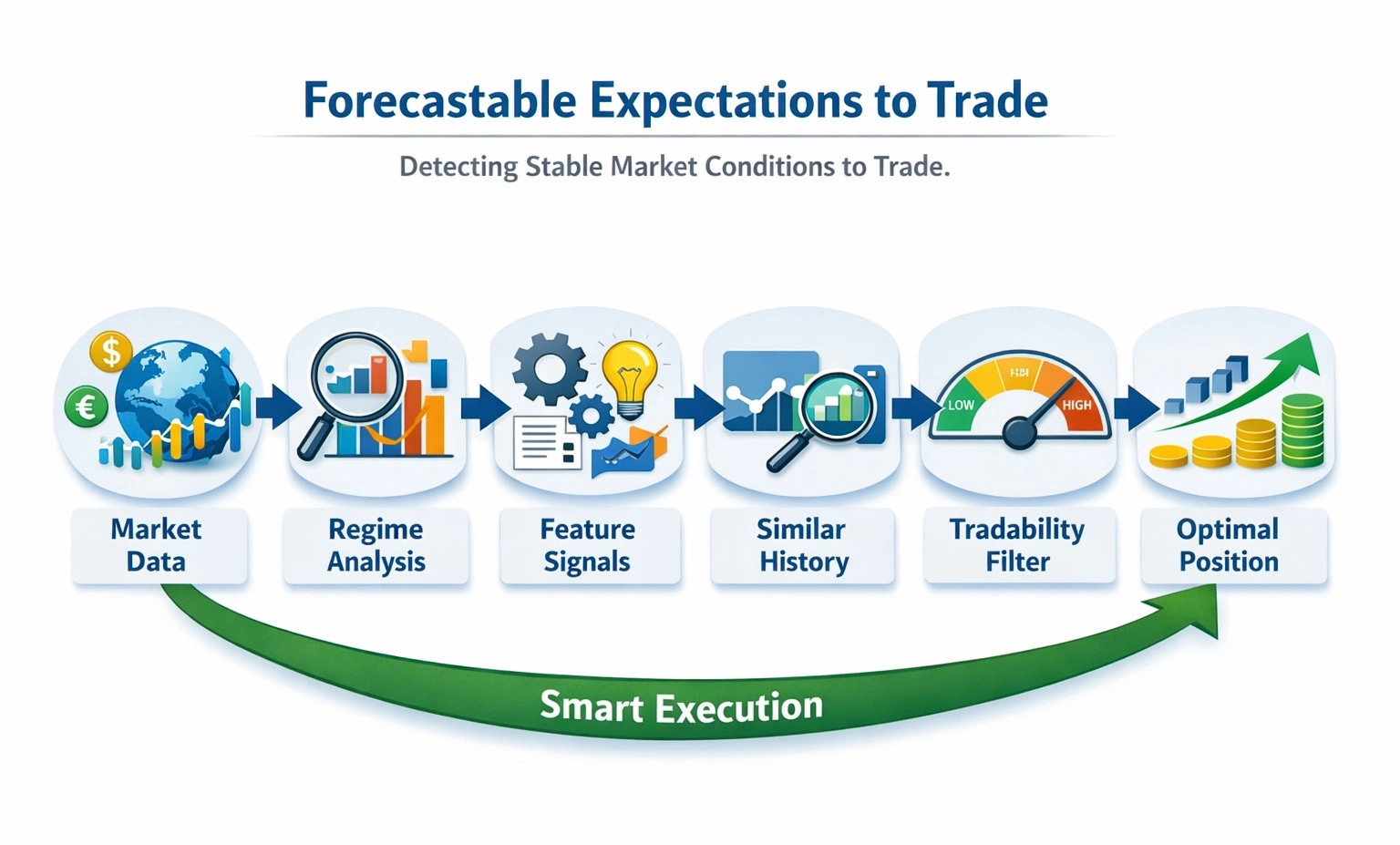
Primebone is a system that waits, watches, and measures the market’s internal consistency. Only when that consistency resolves does it generate asset allocation transmission mappings within a Shariah-compliant universe of sukuk ETFs (SP Funds Dow Jones Global Sukuk ETF), gold (iShares Gold Trust Micro ETF), and screened equities (SP Funds S&P 500 Sharia Industry Exclusions ETF, Wahed Dow Jones Islamic World ETF, and Wahed FTSE USA Shariah ETF).
Signal Anchor Axiom
We do not forecast the target portfolio because the target portfolio is the output of the regime model, not an input to it.
The signal anchors are the only instruments in our ecosystem that are: Liquid enough for high-SNR (Signal-to-Noise Ratio) feature engineering, Exogenous to our investable universe, Structurally stationary across the four macro quadrants.
The Shariah-compliant sleeve—sukuk (SPSK), gold (IAUM), and screened equities (SPUS, HLAL, UMMA)—are regime-dependent receivers of these anchor signals.
Therefore, all forecast capacity is allocated to the anchors; the transmission mapping translates anchor-implied regime probabilities into target-asset betas.
Daily Close-to-Close Workflow
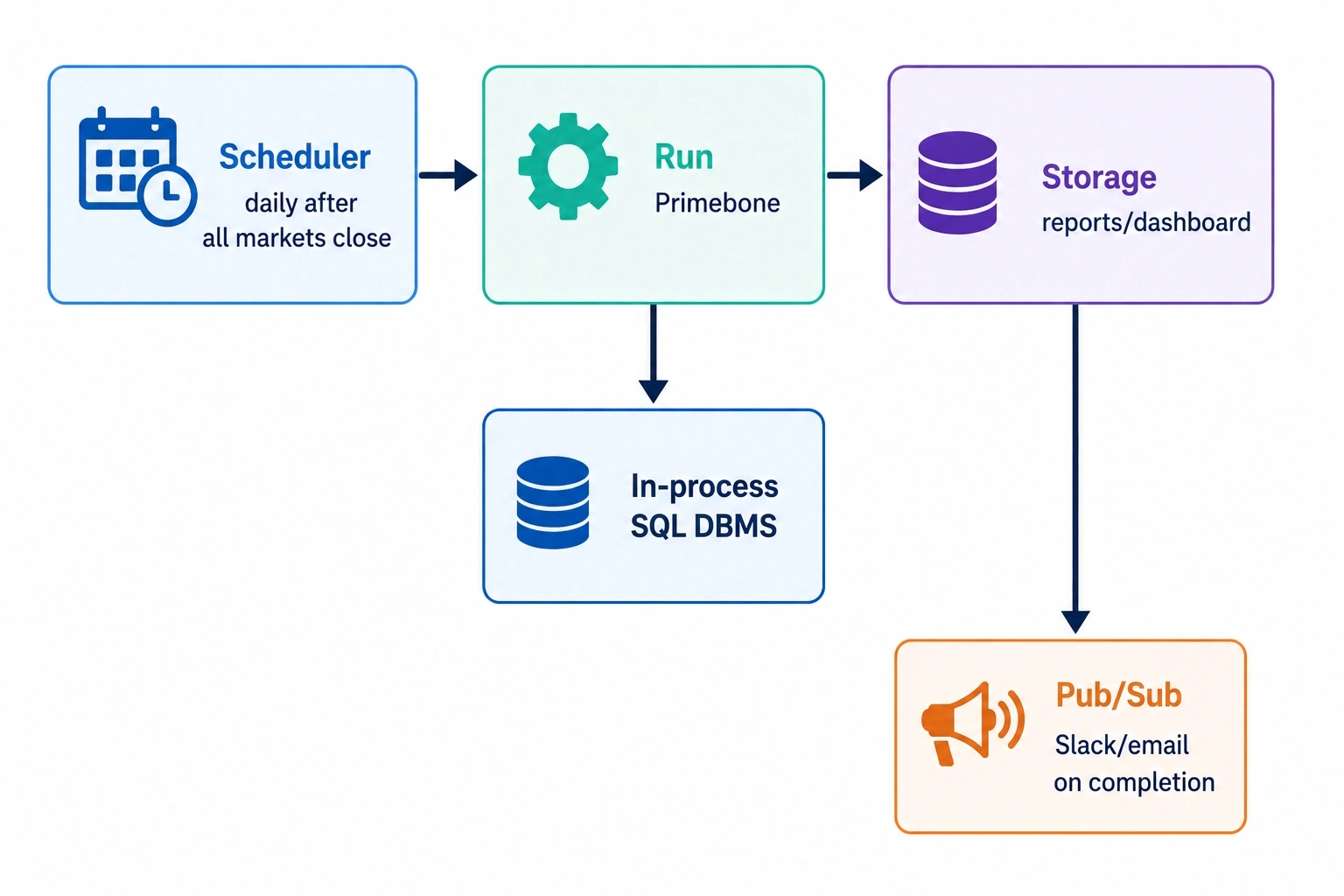
The Primebone framework performs daily synchronization with market conditions by re-running its pipeline after all relevant markets close. Through automated data refreshes and incremental updates, the system generates updated features, identifies current quadrant structures, produces close-anchored forecasts, and translates them into adaptive Shariah-compliant asset allocation mappings.
Primebone Mapping Allocation is derived from machine learning–based analysis of historical economic and technical market data. The output is probabilistic in nature and should not be interpreted as a guarantee of future performance. Outputs represent conditional expectations under estimated macro states, not point forecasts of asset prices. Past regime identification accuracy does not imply future transmission precision. Users assume full responsibility for any investment decisions and associated risks.